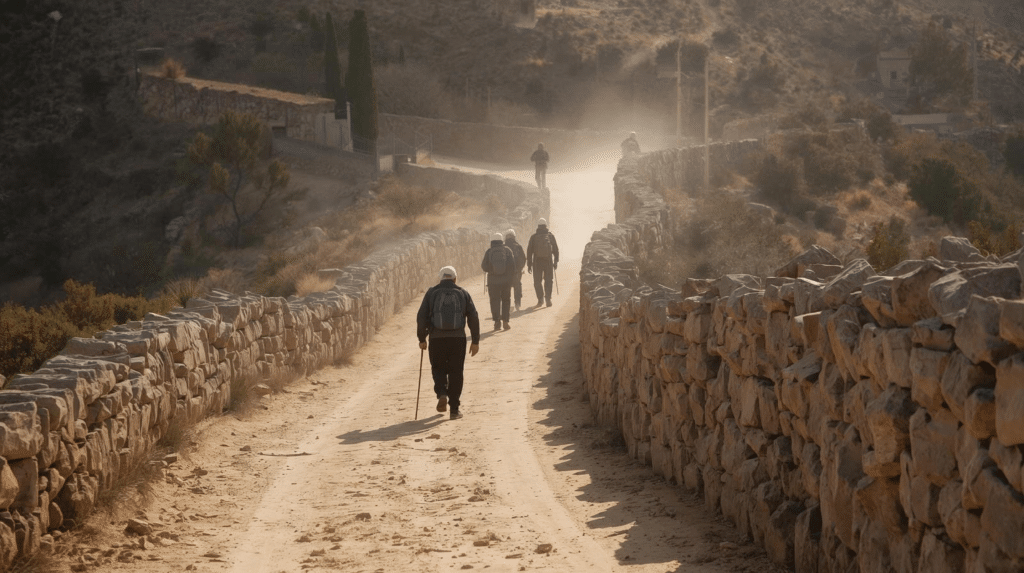
Recently, I was researching plantar fasciitis and came across an excellent forum for the Camino de Santiago (Way of St. James). The ‘Camino’ is a historic network of pilgrimage routes across Europe, predominantly in Spain, leading to the Cathedral of Santiago de Compostela in Galicia, where the Apostle St. James is said to be buried.
There are several different routes for the Camino depending on the pilgrims’ starting point. Camino Francés, starting in Saint-Jean-Pied-de-Port, France, takes about 5–6 weeks to cover approx. 780 km of trail. Of course, this can be a tough task for the body, especially the feet.
- Not all heel pain is plantar fasciitis, but it is the most common cause. Make sure you have the right diagnosis so the treatment is successful.
- Plantar fasciitis –> plantar fasciosis – Any condition that ends with -itis denotes inflammation. Research in the early 2000s showed that tissue removed from patients with heel pain showed no signs of inflammation in the plantar fascia. They all had signs of tissue necrosis or cell death. If there is no evidence of inflammation, treating plantar fasciosis with anti-inflammatory medications is unlikely to be effective.
- Lack of circulation, not inflammation – So if the cause of pain is not inflammation, then what is happening? It is thought that there is a local disturbance in blood flow to the plantar fascia, and the tissue is not receiving enough blood supply to maintain itself or heal. When the muscle that attaches from the underside of the foot from the heel bone and plantar fascia to the big toe, Abductor hallus, is stretched, it reduces the blood flow to the plantar fascia. This stretched position occurs when the big toe is forced against the 2nd toe due to a shoe’s narrow toe box, and when the big toe is held off the ground by the shoe’s toe spring or rocker at the front.
- Tendons get looser as we age – people over the age of 70 have 44% less tendon stiffness than younger adults, which causes a 17% higher workload while walking. If tendons and fascia are getting looser, then stretching alone is unlikely to be a solution. When the tendon is less stiff, the muscle takes up the slack and works in a shortened position, which cannot generate as much force. The tendon is less stiff and doesn’t store energy and recoil, so the muscle has to work harder. It’s a double whammy.
- train the muscle, and the tendons and fascia – getting the muscles of the foot and calf are indeed important to strengthen, but as discussed above, the training needs to incorporate exercises that target the tendons and fascia. Isometric exercises and strengthening at the end of a muscle’s range are much more efficient ways to build strength and condition tendons. People with PF pain often have peroneal muscle weakness (peroneus longus, a muscle on the outer side of the leg), but this is rarely addressed. In fact, a study of 202 people with PF found that peroneal weakness was the strongest predictor of developing plantar fasciitis. Also, exercises to strengthen the intrinsic muscles of the foot are sometimes difficult to master (e.g. ‘short foot’ exercises) and may not get the loads necessary to strengthen the muscles effectively. At Unity Osteopathy we can assess toe and lower leg muscle strength to find any weaknesses and then devlop a sterngthening programme to address these. We also stock the ToePro, speciifcally designes to address these weaknesses.
- “About 80% of these [cases] resolve on their own within a year.” – Research indicates that 44% of patients with plantar fasciitis will have pain 15 years after the original diagnosis. That may be because standard treatments focus on inflammation rather than on addressing deficits in strength and mobility.
- Address calf tightness -Calf tightness causes premature lifting of the heel during pushoff, transferring excessive force to the attachment of the plantar fascia via the Achilles tendon. Restoring calf flexibility is one of the most important things you can do to prevent PF injury from turning chronic. This is not an easy task with the standard stretching protocols used to date. More recent research has shown that higher volume stretching programmes are more effective.
- Caution with corticosteroid injections – As mentioned above (1, 2, and 3), you need an accurate diagnosis for the treatment to work. In a 2017 review comparing corticosteroid injections with placebo, corticosteroids slightly improved symptoms during the first 4 weeks but not thereafter. There are risks associated with steroid injections, e.g., weakening of the connective tissue and a higher risk of rupture, so please carefully consider having injections.